
Why Splitting One Loan Into Several Smaller Loans Can Cost More in Singapore
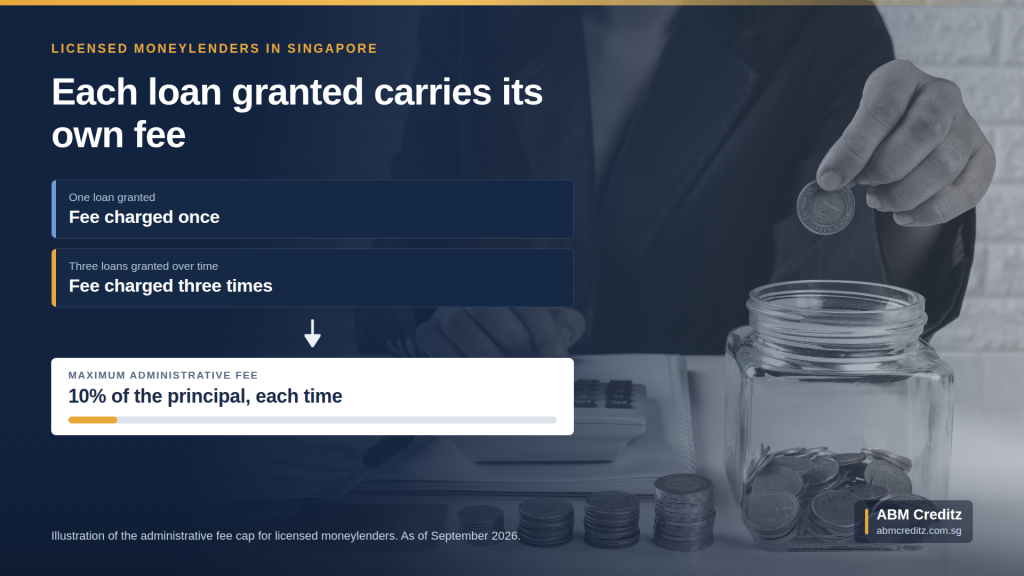
You need S$6,000. You could take it as one loan, or as three smaller loans of S$2,000 — now, next month, and the month after. The interest cap is the same either way. What changes is how many times a fee is charged, how much late-payment exposure you carry, and how much borrowing room you have left afterwards. Two of those work against you, and the third is fixed by law regardless of how you arrange things. Why does splitting one loan into several smaller loans cost more in Singapore? Splitting adds cost in two specific ways. Licensed moneylenders in Singapore may charge an administrative fee of up to 10% of the principal each time a loan is granted, so borrowing three separate times means that fee is charged three times. Late fees of up to S$60 for each month of late repayment apply to each loan separately, so three loans carry up to S$180 a month in late fees instead of S$60. These limits are as of September 2026. What splitting does not do is create extra borrowing room. The unsecured borrowing cap is aggregate across all licensed moneylenders combined, not per lender. Is it cheaper to take one bigger loan or two smaller loans from a licensed moneylender? For the same total borrowed at the same time, the difference is smaller than most borrowers expect. The administrative fee is a percentage, so 10% of one S$6,000 loan is S$600, and 10% of three S$2,000 loans is also S$600. The maximum interest rate is 4% per month either way, as of September 2026. What does change is your late-payment exposure and the number of repayment schedules you have to keep track of. One S$6,000 loan compared with three S$2,000 loans, using maximum permitted charges as of September 2026. Illustration only. One S$6,000 loan Three S$2,000 loans Total principal S$6,000 S$6,000 Maximum administrative fee (10% of principal) S$600 S$600 (S$200 × 3) Maximum interest rate 4% per month 4% per month on each loan Maximum late fee if you miss one month S$60 S$180 (S$60 × 3) Separate repayment schedules 1 3 Separate cost ceilings One, capped at S$6,000 Three, capped at S$2,000 each The real cost gap opens up when the loans are taken at different times rather than together. How much extra do you actually pay in fees when you take multiple loans instead of one? Because the administrative fee is charged each time a loan is granted, borrowing repeatedly costs more than borrowing once — even when you never hold a large amount at any point. Take a borrower who needs S$2,000 in January, repays it, needs S$2,000 again in May, repays that, then needs S$2,000 in September. Three loans have been granted, so the maximum administrative fee is S$200 on each, or S$600 in total. A borrower who took one S$2,000 loan and held it for the year pays that fee once: up to S$200. Both borrowers were never more than S$2,000 in debt to a licensed moneylender. One paid up to three times the fee. Interest works differently and can pull the other way. Interest is calculated on the monthly outstanding principal after payments have been applied to principal, so holding a smaller balance for a shorter time means less interest. Borrowing small and repaying quickly is not automatically expensive — borrowing small repeatedly is what stacks up the fees. These figures use the maximum charges permitted by law. They are an illustration, not a quotation. Actual charges depend on the lender’s assessment and the terms of the signed agreement. Is the 10% administrative fee charged on the loan amount, or on the cash I actually receive? The fee can be up to 10% of the principal, and a licensed moneylender in Singapore may deduct it upfront when the loan is granted. On a S$2,000 loan where the full fee is deducted, you would receive S$1,800 while your contractual principal remains S$2,000. The 10% figure is a maximum, not a fixed charge, as of September 2026. Does taking multiple loans affect how much I can borrow in total in Singapore? Yes. The unsecured borrowing cap set under the Moneylenders Act applies across all licensed moneylenders combined, not per lender, so an existing loan reduces what any other licensed moneylender can lend you. Approaching a second or third moneylender does not raise the total. Loans are checked through the Moneylenders Credit Bureau (MLCB) when you apply. Maximum aggregate unsecured borrowing across all licensed moneylenders in Singapore, as of September 2026. Annual income Singapore Citizens and PRs Foreigners residing in Singapore Below S$10,000 S$3,000 S$500 S$10,000 to below S$20,000 S$3,000 S$3,000 S$20,000 and above 6 times monthly income 6 times monthly income These tiers are published by the Registry of Moneylenders, Ministry of Law, in its FAQs on borrowing from licensed moneylenders. Does the cap count only licensed moneylender loans, or my bank and credit card debt too? The statutory cap is calculated from unsecured loans granted by licensed moneylenders. Bank loans and credit card balances do not form part of that particular calculation. They can still matter, because a licensed moneylender must assess your ability to repay before granting a loan, and your wider commitments are part of that assessment. Does the cap apply to what I originally borrowed, or what I still owe? For an unsecured loan, the cap is worked out by adding the amount of the proposed new loan to your outstanding unsecured loan amount with licensed moneylenders, as shown in the credit report. That outstanding figure excludes interest, late interest and fees. Repaying principal therefore reduces the amount counted against you, but it does not entitle you to a new loan. Approval is subject to the lender’s assessment of your income, existing loans and repayment ability. Do secured loans count towards the same cap as unsecured loans? No. The tiers above apply to unsecured borrowing. For secured loans, there is no prescribed maximum amount, as of September 2026. Can the
Why Your 4th Loan Application Got Rejected — Why MLCB Record Matters and What Your MLCB Record Says About You?

A rejection from a licensed moneylender can happen even when you are employed and earning. The reasons sit in the borrowing rules licensed moneylenders in Singapore must follow, and in the lender’s assessment. This page sets out six reasons an application is turned down, and how to tell which applies to you. Why was my loan application rejected even though I have a job and income? Being employed does not by itself qualify you to borrow. Licensed moneylenders in Singapore must apply borrowing caps set under the Moneylenders Act, and must obtain a credit report from the Moneylenders Credit Bureau (MLCB) before granting a loan. An application can be turned down because you have reached your aggregate cap, your income tier limits you, you are listed for self-exclusion, your repayment record, or the lender’s assessment. You have already reached your aggregate cap. As of August 2026, the unsecured borrowing cap applies across all licensed moneylenders combined, not once per lender. Your annual income is below S$20,000. A Singapore Citizen or Permanent Resident earning less than S$20,000 a year can borrow at most S$3,000 unsecured in total. You are a foreigner in a lower income tier. Foreigners residing in Singapore are capped at S$500 where annual income is below S$10,000, and S$3,000 from S$10,000 to below S$20,000. You are listed for self-exclusion with the MLCB. A self-exclusion listing blocks new unsecured loans from licensed moneylenders, with debt consolidation loans excepted. Your repayment record. The MLCB record shows whether each instalment that fell due was paid on time. The lender’s assessment. Under the Moneylenders Act, the report is used to assess creditworthiness and set the maximum that may be lent. Approval is subject to the lender’s assessment of your income, existing loans and repayment ability. What exactly do licensed moneylenders see when they pull my MLCB record? A licensed moneylender in Singapore must obtain a credit report from the Moneylenders Credit Bureau (MLCB) before granting a loan. The Loan Information Report shows which licensed moneylenders you have outstanding loans with, whether each instalment due was paid on time, amounts outstanding including interest and fees, your aggregate secured and unsecured borrowing, and the aggregate amount of your pending unsecured loan applications. Your report shows the aggregate amount of pending applications, not every application you have ever made. A licensed moneylender that declines your application must notify the bureau and give the reason. What the MLCB record does not contain The MLCB holds factual loan and repayment information, with no bureau score or risk grade of the kind a Credit Bureau Singapore (CBS) report carries. It does not collect bank credit facilities or deposit data, so bank loans, credit cards and mortgages are not reflected. Who can see my MLCB record, and can I get a copy? The Moneylenders Act permits the Loan Information Report to be disclosed to you, to licensed moneylenders, and to the Registrar and public agencies in specified circumstances. It is not a public credit file, and not something an employer or family member can look up. You can buy your own report for S$0.50 including GST through the MLCB website with Singpass identity verification, or at the Credit Counselling Singapore office. How much borrowing headroom do I actually have left right now? The unsecured borrowing cap for loans from licensed moneylenders in Singapore is an aggregate across all licensed moneylenders combined. Your headroom is that cap minus what you already owe on unsecured loans, so borrowing from one lender reduces what any other can lend you. Secured loans have no cap. Table: Unsecured borrowing caps for loans from licensed moneylenders in Singapore, as of August 2026 Borrower Annual income Maximum unsecured borrowing, all licensed moneylenders combined Singapore Citizen or Permanent Resident Below S$20,000 S$3,000 Singapore Citizen or Permanent Resident S$20,000 and above 6 times monthly income Foreigner residing in Singapore Below S$10,000 S$500 Foreigner residing in Singapore S$10,000 to below S$20,000 S$3,000 Foreigner residing in Singapore S$20,000 and above 6 times monthly income Any borrower, secured loans Any No cap Does a secured loan count towards my S$3,000 or 6x monthly income cap? No. The caps licensed moneylenders in Singapore must apply are caps on unsecured lending; secured loans carry no cap under the Moneylenders Act. Worked example: how remaining headroom is calculated These figures illustrate the arithmetic; they are not a real borrower. A Singapore Citizen earns S$3,000 a month, or S$36,000 a year — above the S$20,000 threshold, so the cap is six times monthly income. Cap: 6 x S$3,000 = S$18,000 Outstanding unsecured loan, Lender A: S$11,000 Outstanding unsecured loan, Lender B: S$4,500 Total outstanding: S$15,500 Remaining headroom: S$18,000 − S$15,500 = S$2,500 Here, a third licensed moneylender could not lend more than S$2,500 unsecured. If my loan application is rejected, do I have to pay anything? A licensed moneylender in Singapore may charge an administrative fee of at most 10% of the principal, and that fee is chargeable when the loan is granted. Where no loan is granted, that fee does not arise, so a rejected application carries no administrative fee. As of August 2026, the charges a licensed moneylender may impose are limited to interest of at most 4% per month, late interest of at most 4% per month on the amount repaid late, a late fee of at most S$60 for each month of late repayment, the administrative fee, and court-ordered legal costs. Interest and all fees added together can never exceed the loan principal. A demand to transfer money before a loan is disbursed is not one of those permitted charges, and MinLaw warns against practices such as withholding part of the principal. How do I improve my MLCB record before I apply again? Nothing you do makes approval certain — approval is subject to the lender’s assessment of your income, existing loans and repayment ability. What you can do is remove the obstacles you control: read your own record, bring your outstanding unsecured borrowing down, correct anything inaccurate, and get